






Summary: Most commercial transactions use payment terms, typically referred to as offering “Net 30 – 60 days.” These terms are a form of credit that typically gives clients 30 to 60 days to pay an invoice. Companies must offer payment terms if they want to remain competitive, especially when bidding for large opportunities. However, offering […]
Blog
How Does Purchase Order Financing Work?
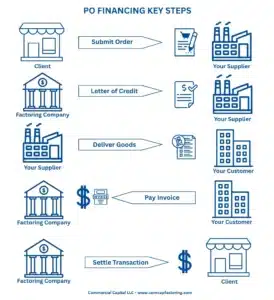
Summary: Purchase order (PO) financing helps small businesses that have a large order and need funds to pay their vendors. It helps cover your supplier expense, enabling you to fulfill the order and book the revenue. While this solution is flexible, it works only with specific transactions. This article explains how PO financing works, who […]
What is Special Assets? What Should You Expect?

Summary: The Special Assets department handles loans that are out of compliance and in trouble. Lenders assign loans to this department to mitigate potential losses. This change marks a turning point in your relationship with the lender, as they likely want to exit the lending relationship. A company can improve its chances of success in […]
Cash Conversion Cycle Calculator
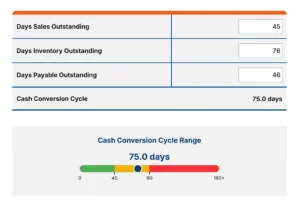
The cash conversion cycle measures how long it takes your company to sell it’s inventory. collect invoices, and pay vendors. It’s an important metric because it shows how efficiently your business turns operating activity into cash. An increasing cash conversion cycle may indicate that cash is tied up for longer. This can happen because of […]
Advantages and Disadvantages of Non Recourse Factoring

Non-recourse invoice factoring plans have quickly become very popular with Canadian companies that are looking for a factoring plan. The main advantage of non-recourse plans is that the factoring company absorbs the loss of advance, if your customer does not pay due to a credit reason. Factoring companies use different rules to define what is a qualifying ‘credit […]
What is Non-Recourse Factoring?

Non-recourse factoring is a type factoring financing in which the factoring company assumes the loss if invoices are not paid due to end customer insolvency. It is one of the two common types of invoice factoring offered by Canadian factoring companies. However, it is also widely misunderstood by clients. In this article, we discuss: 1. […]
DSO Calculator
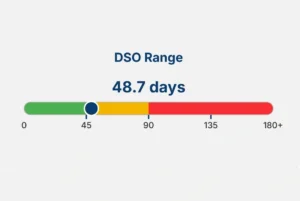
Days Sales Outstanding (DSO) measures how long your customers take to pay their invoices, on average. It’s an important metric because it provides a general gauge of your collections performance. An increasing DSO may indicate collection delays and potential cash flow problems. Formula: DSO = (Average Accounts Receivable ÷ Total Credit Sales) × Number of […]
DIO Calculator
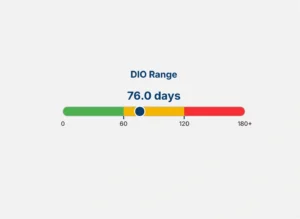
Days Inventory Outstanding (DIO) measures how long your company holds inventory before it is sold or used, on average. It’s an important metric because it provides a general gauge of your inventory management efficiency. An increasing DIO may indicate slow-moving inventory, excess stock, or potential cash flow problems. Formula: DIO = (Average Inventory ÷ Cost […]
DPO Calculator
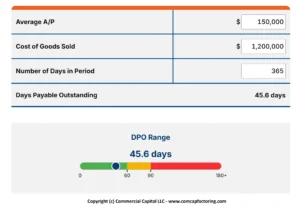
Days Payable Outstanding (DPO) measures how long your company takes to pay its suppliers, on average. It’s an important metric because it provides a general gauge of how your business manages supplier payments and cash flow. An increasing DPO may indicate that your company is taking longer to pay bills. This can improve short-term cash […]
Financing Sales to Big Box Retailers

Becoming a distributor for a large big box retailer – companies such as Walmart, Loblaws, or Rona- can be both a important opportunity and a major challenge at the same time. Most big retailers can place large purchase contracts, which are great for revenues. However, they also negotiate payment terms that enable them to pay your invoices […]