





Payroll financing is a solution that allows your company to finance invoices and assets so that it can make payroll. It usually refers to a common use of invoice factoring, though it can also refer to other solutions.
In this article, we cover:
- Understanding the problem
- Credit terms kill cash flow
- How does payroll funding work?
- How much does it cost?
- Qualification
- Advantages and disadvantages
- Common business uses
- Available industries
1. Do you have this problem?
Making payroll is one of the biggest responsibilities for a business owner. Your employees depend on you just as much as your business depends on them. As their boss, you want to make sure they are always paid on time. The success of your business depends on it.
But making payroll can be difficult, especially for small and growing companies. This is because they often run into cash flow problems. Small companies can experience cash flow problems for many reasons. However, the most common reason is having to offer net-30 day payment terms to clients, even when you can’t afford to.
2. Net-30-day credit terms kill cash flow
Large and midsize companies demand payment terms as a condition of buying from you. They do this because it improves their cash flow and doesn’t cost them anything. However, slow payments cost you quite a bit. While you wait to get paid, you have to pay your employees from your cash reserves. And if your cash reserves run low, you get into trouble.
A simple way to solve this problem is to offer early payment discounts to your clients. Basically, you give clients a 2% discount if they pay invoices in 10 days or less. Early payment discounts can work very well but have some limitations. Your clients have to agree to them, and you are left in a vulnerable position. Your clients can stop paying quickly at any time.
In most cases, a better solution is to fund your payroll using an invoice factoring program.
3. How does payroll funding work?
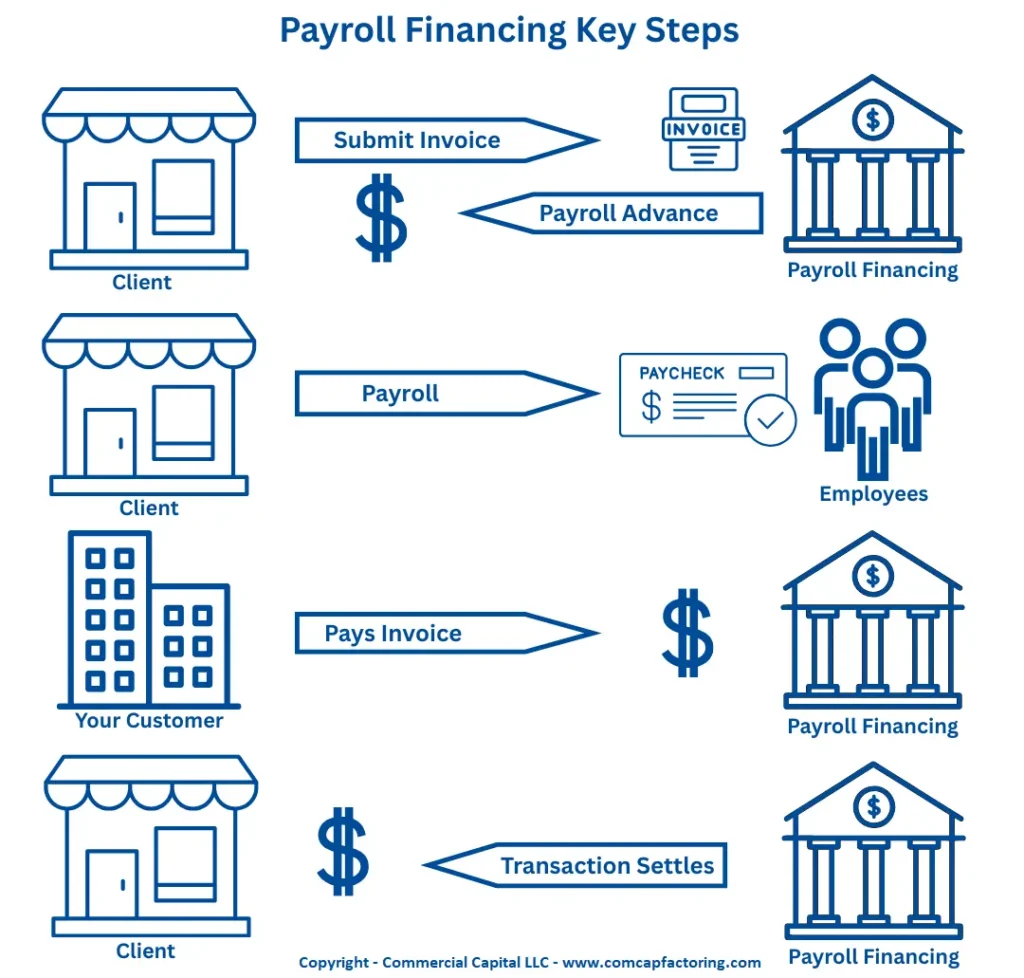
Using invoice factoring to finance payroll is relatively simple. You agree to sell your accounts receivable to the payroll funding company, which buys them in two installment payments.
The first installment is called the advance and covers 80% to 95% (varies by industry) of your receivables. The funds are usually deposited into your bank account within a business day. The advance provides you the immediate funds to pay employees and other company expenses.
The second installment is deposited as soon as your customer pays the invoice in full. At that time, the payroll finance company rebates the remaining funds, less a financing fee. The following diagram shows the key steps in the payroll financing process.
Learn more by reading “What is factoring and how does it work?“
4. How much does payroll financing cost?
The cost of using a payroll financing program is based on the amount of funds you need, the commercial credit quality of your clients, and the transaction’s general risk. Costs typically range from 1.15% to 3.5% per 30 days. Larger companies can get even lower prices. Learn more about typical factoring rates.
5. Qualification
Qualifying to use payroll financing is easier than qualifying for other solutions. Payroll funding is open to small businesses, growing companies, and companies that have financial challenges. In general, to qualify, your company must have:
Most financing plans can be deployed in a week or less. Once deployed, you can use it to get your receivables financed as required.
6. Advantages and disadvantages
Using an invoice factoring plan to finance payroll has several advantages. Here are some of the most important ones:
However, factoring is not a perfect solution and has some disadvantages. The three most important disadvantages are:
7. Common business uses
The following examples show how payroll financing is used in real-world situations. Each one addresses a common cash flow challenge faced by businesses.
a. Staffing agency with fast-paced growth
An entrepreneur used her savings to launch a staffing agency that grew faster than she expected. The business encountered a common cash flow problem. Its staffing clients paid their invoices in 30 to 60 days. However, her employees needed to be paid weekly.
The company’s cash flow became strained. Profits were growing at a healthy rate. However, covering payroll was becoming increasingly difficult.
The staffing company evaluated payroll financing companies and selected a facility with a 90% advance rate. Consequently, cash flow improved while the company maintained its strong growth rate.
b. Consulting company with slow-paying clients
A consulting company signed long-term contracts with large corporate clients. These clients provided a steady flow of work. However, they paid their invoices in 45 to 60 days. This was a challenge for the firm because it didn’t have a cash reserve and had to pay its employees every two weeks.
The consulting company solved its cash flow problem with a payroll financing line. The line provided a 90% advance rate, which allowed the company to cover payroll and other business expenses. With its improving cash flow, the company could begin building a cash reserve and eventually finance operations on its own.
8. Who can benefit from this solution?
Payroll financing helps companies that depend heavily on payroll. However, factoring can help any company that has to wait up to 90 days for commercial/government clients to pay. Common industries include:
For most of these companies, factoring is the right solution for payroll financing. It is specifically designed to fix cash flow problems that originate from slow-paying clients.
Do you need payroll funding?
We are a leading payroll financing company and can provide you with a competitive proposal. For a quote, fill out this form or call (877) 300 3258.

Marco Terry is the Managing Director of Commercial Capital LLC and has over two decades of experience in asset-based finance. He has worked with small and mid-sized companies across the United States, Canada, and Australia. Marco holds a Master of Science in Finance.